REIMAGINING FOOD ASSISTANCE PROGRAMS IN MICHIGAN

A project aimed at improving EBT usability and accessibility in Michigan while reducing its social stigma through design.
ROLE:
UX DESIGNER
DURATION:
THREE WEEKS
TEAM:
3 DESIGNERS
3 RESEARCHERS
TOOLS:
FIGMA

Overview
Breaking barriers in food assistance.
1.3 million Michiganders across diverse ages, demographics, and abilities rely on food assistance but face significant obstacles in the application process. The program suffers from outdated, inaccessible design that fails many users. Additionally, SNAP recipients face harmful stigma perpetuated by politicized narratives, despite fraud representing only 1% of total benefits.
Overview
Breaking barriers in food assistance.
1.3 million Michiganders across diverse ages, demographics, and abilities rely on food assistance but face significant barriers in the application process. The program suffers from outdated, inaccessible design that fails many users. Additionally, SNAP recipients face harmful stigma perpetuated by politicized narratives, despite fraud representing only 1% of total benefits.
Problem
How might we redesign the food assistance application and EBT systems to be simple, stigma free, & flexible for Michiganders?
the research
Demographics
30%
of SNAP households include seniors aged 60 or older.
44%
of SNAP recipients are children, & similar trends in Michigan, where families with children frequently qualify due to income limitations.
1.3M
people rely on government benefits to afford groceries in Michigan.
User Personas
After conducting an in-depth assessment of our user base, our research team developed three detailed persona archetypes. Each archetype represents a distinct user group, highlighting their key characteristics, goals, needs, and potential challenges.


the proof
Challenges & Stigma
70%
Of Michiganders have faced barriers to enrolling in SNAP due to societal stigma, including:
-
Concerns about publicly using the bright orange Bridge Card
-
Fear of judgment or negative interactions with cashiers or caseworkers
Negative Perceptions
Despite the fact that SNAP fraud accounts for only 1% of total benefits, it is frequently politicized and unfairly linked to marginalized communities, perpetuating harmful stereotypes.
Challenging Application Process
60%
Of respondents find the SNAP EBT application process highly challenging and not direct, giving it a rating of 4 or 5 on a scale where 5 represents the most difficult.
Survey Highlights
User 1: "A lot of questions are not super straight-forward and you have to be extremely specific/detailed. For example, I didn’t know if I had to list my roommates during the household process because we would eat and pay rent/utilities separately."
User 2: "[Benefits are not really enough], since it only covers enough food for a single person (mom)."
User 3: "I don’t use it currently, but used to feel a bit embarrassed by how recognizable the card is"
Solutions
Simplifying the Application Process
To streamline the application, the design team implemented a quick eligibility quiz that helps applicants assess their likelihood of qualifying upfront. This saves time, reduces frustration, and helps qualified individuals proceed confidently.
Revamping the physical EBT Cards
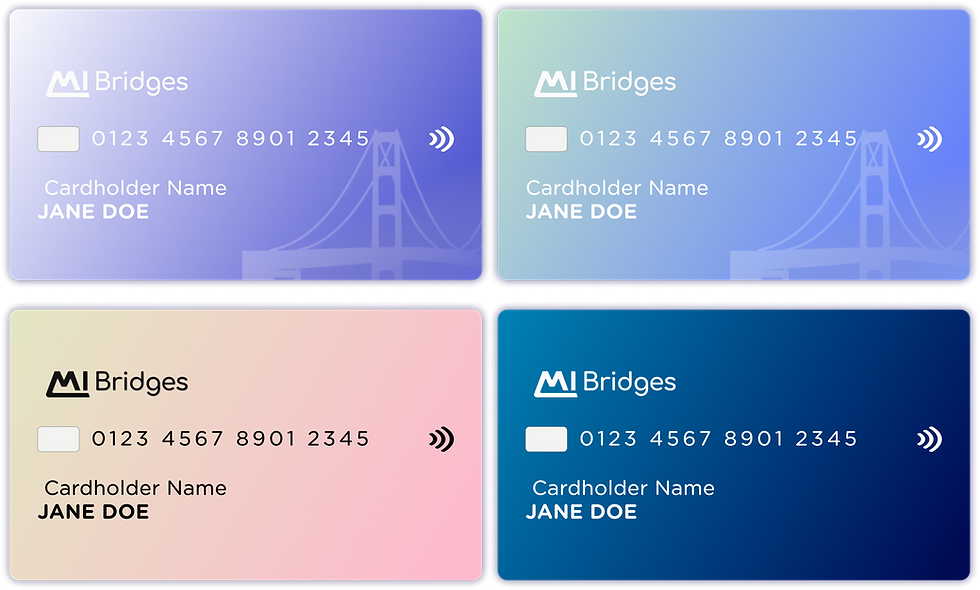
A common issue discovered among EBT users is dissatisfaction with the current card design. Users expressed feelings of shame and embarrassment when using the bright orange cards in stores. Considering all the negative social stigma attached to EBT cards, the emergence of virtual cards, and our users' privacy in mind, we designed new and improved physical and digital cards.
The EBT cards we designed resemble credit/debit cards.

Digitizing EBT Cards
To address checkout stigma, we digitized EBT for Apple Pay and Google Pay. Users gain discreet payment options, real-time balance visibility, and the convenience of managing everything in one place - no physical cards, receipts, or separate logins needed.


What did i learn
Final Takeaways
This project challenged us to tackle a "wicked problem," because it resonated personally which many of us had direct or secondhand experience with the system's barriers. Reimagining such an entrenched, complex program came with significant challenges, particularly coordinating a large team and dividing responsibilities effectively. These obstacles became opportunities for growth, strengthening my ability to navigate ambiguity and collaborate at scale.
What's next?
We connected with a Michigan Food Assistance program employee who affirmed both the need for change and the challenges of implementation. The next step is partnering with stakeholders to pilot these solutions - recognizing that systemic change is challenging but essential to improving the experience for 1.3 million Michiganders.